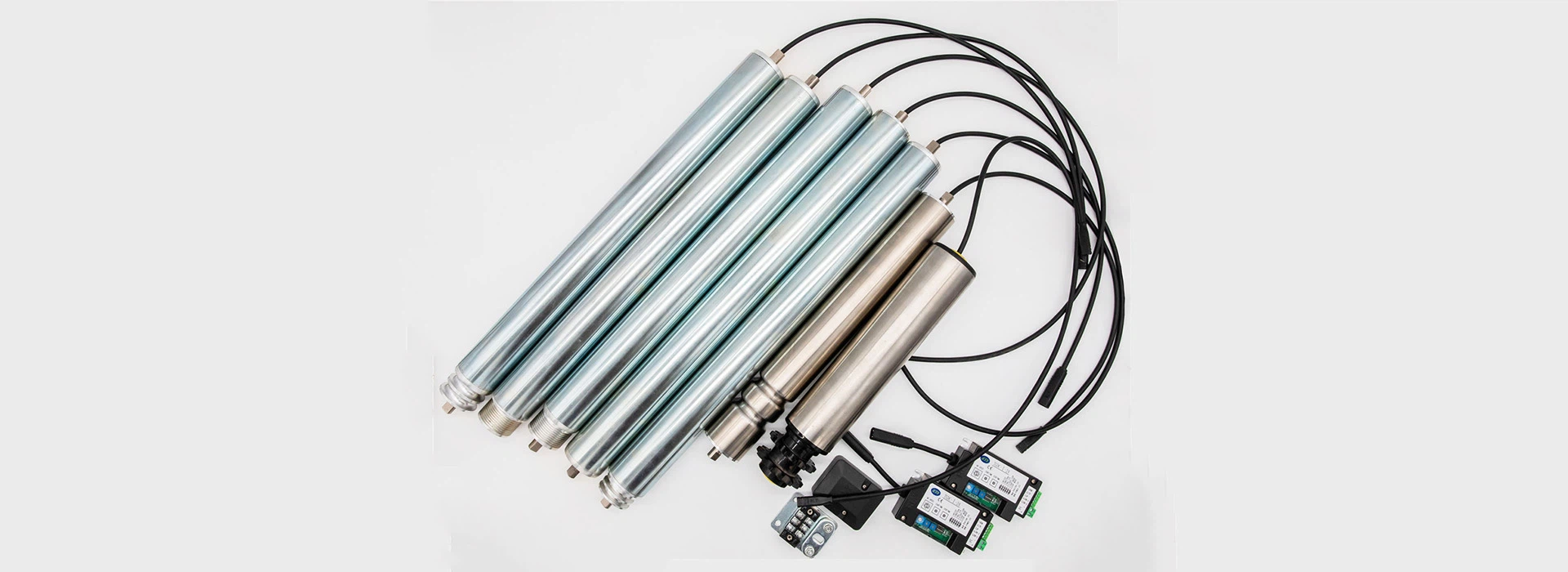
Brief Introduction to Drum Motor
The appearance of a drum motor is similar to that of a drum, and it is mainly composed of a housing, a rotor, a stator, a bearing, and other parts. Drum motors have been widely used in many fields. For example, in the chemical industry, drum motors are often used as drive motors for conveyors, providing stable and reliable power support for various conveying equipment. In addition, drum motors can also be used in other occasions that require efficient and stable power output.
Compact Structure And Space Saving
Drum motor has a very compact overall structure because the motor and the reduction gear are integrated into the drum body. Compared with the traditional split motor and reduction gear combination, it greatly saves installation space. This is especially important for occasions with limited space, such as small conveyors, production lines, etc.
Easy Installation And Convenient Maintenance
Drum motor’s integrated design simplifies the installation process and reduces the connection and debugging work between components. At the same time, due to its compact structure, it is also more convenient to maintain, reducing maintenance costs and difficulties.
High Transmission Efficiency
Drum motor’s motor and reduction gear are directly connected, which reduces energy loss during power transmission and improves transmission efficiency. This helps to improve the overall performance and efficiency of the equipment.
Smooth Operation And Low Noise
Drum motor’s reduction gear is well designed, which can effectively reduce vibration and noise during equipment operation. This is of great significance for improving the working environment and protecting the hearing of operators.
Strong Adaptability
Drum motor can be customized according to different application requirements, such as different speeds, torques, sizes, etc. This enables Drum motor to be widely used in various conveyors and transmission systems to meet the use requirements under different working conditions.
Improve Equipment Reliability
Since the drum motor integrates the motor and the reduction device, the connection points between the components are reduced, thereby reducing the risk of failure due to loose connections or wear. This helps to improve the reliability and stability of the equipment.
Reduce Energy Consumption
The efficient transmission system enables the drum motor to use electrical energy more effectively and reduce energy consumption during operation. This is of great significance for energy conservation and emission reduction and reducing production costs.
Drum Motor Housing
The housing of a drum motor has an internal cavity for accommodating the core components of the motor. The outer cross-section of the housing may be angular, especially in the section used for torque transmission, which helps to transmit torque more efficiently.
Motor Components
The rotor and stator are the core components of the motor. The stator is fixed in the housing, and the rotor can rotate inside the stator. It can convert electrical energy into mechanical energy through the principle of electromagnetic induction to drive the rotor to rotate.
Journal
It is the part set at both ends of the drum motor housing, used to support and fix the rotor and transmit torque. There are usually two journals, located at the first end and the second end of the housing.
Electrical Components
Electrical components include windings, brushes, commutators, etc. These components are important components inside the motor and are responsible for the conversion and transmission of electrical energy. It can ensure that the motor can work normally and output stable power.
Direct Drive Drum Motor
This type of drum motor integrates the motor directly inside the drum, without additional reduction gear, and directly drives the drum to rotate. It has a compact structure, high transmission efficiency, and simple maintenance. It is suitable for occasions with strict space requirements and high-efficiency transmission.
Reduced Drum Motor
This type of drum motor adds a reduction gear between the motor and the drum to reduce the output speed of the motor and increase the torque. It can provide greater torque output and adapt to a wider range of working conditions. It is suitable for conveying systems that require low speed and high torque, such as heavy material conveying, mining machinery, etc.
Conveying Material Characteristics
Material characteristics such as weight, volume, shape, and friction coefficient will affect the selection of drum motors. For example, heavy materials require drum motors with greater torque, while slippery materials may require rollers with specially treated surfaces.
Conveying Speed
Select a drum motor with appropriate speed and torque according to the speed requirements of the production line. Too fast a speed may cause the material to slip or be damaged, while too slow a speed may affect production efficiency.
Rated Power
Select a drum motor with sufficient rated power according to the required driving force and power loss. Too much power may increase energy consumption and costs, while too little power may not meet the driving requirements.
Torque
Torque is a key parameter for the output power of a drum motor. Select a drum motor with sufficient torque according to the weight of the conveyed material and the required driving force.
Speed
Speed is directly related to conveying speed. Select a drum motor with appropriate speed according to the speed requirements of the production line. Note that too high a speed may increase mechanical wear and noise.
Efficiency
Selecting a high-efficiency drum motor can reduce energy consumption and operating costs. High-efficiency drum motors usually have better heat dissipation performance and longer service life.
Application Of Drum Motor
Logistics Delivery System
Drum motor plays an important role in logistics transportation systems, especially in supermarkets, warehouses, factories and other places that require efficient and continuous material transportation. As the power source of the belt conveyor, it can drive the conveyor belt to operate continuously to achieve fast and accurate transportation of materials.
Food Processing Industry
In the food processing industry, Drum motor also plays an important role. The development and application of food machinery motors have made significant progress in recent decades. Modern food machinery motors usually adopt high-efficiency, low-energy-consumption designs. Drum motors, as one of the forms, are used for stirring, mixing, and cutting. , pressing, baking, filling and other food processing operations.
Other Industrial Areas
In addition to logistics conveying systems and the food processing industry, Drum motor is also widely used in other industrial fields. For example, in the pharmaceutical industry, Drum motor can be used to drive tablet machinery, water injection machinery, antibiotic powder injection machinery and other equipment; in the building materials industry, Drum motor can be used as the power source for concrete mixing stations, asphalt mixing stations and other equipment. ; In the metallurgical industry, Drum motor can be used to drive equipment such as ore conveyor belts and steelmaking production lines.
We're well-known as one of the leading drum motor suppliers in China. If you're going to buy high quality drum motor at competitive price, welcome to get more information from our factory. Also, customized service is available.
(0/10)