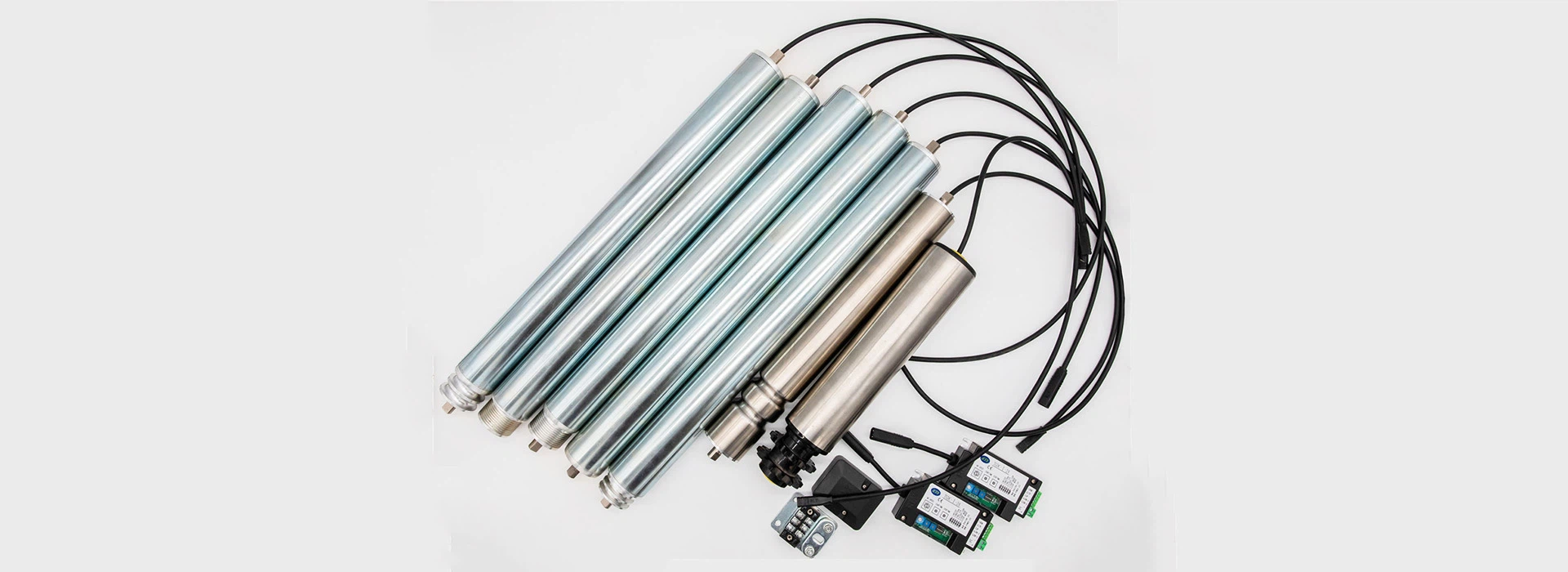
Key Benefits and Application
Drum motors offer significant advantages over traditional drive systems, making them the preferred choice across many industries.
Space-Saving Design: By eliminating the external motor and gearbox, the conveyor's overall footprint is drastically reduced. This is crucial for retrofitting into existing, cramped spaces or for designing compact machinery .
Safety and Cleanliness: With no external chains, sprockets, or guards, the risk of accidents is greatly minimized. The sealed, smooth housing is also easy to clean, making drum motors ideal for food processing, pharmaceutical, and other sanitary environments .
Low Maintenance: The motor and gearbox operate in a sealed oil bath, ensuring permanent lubrication. This "fit and forget" design eliminates the need for regular maintenance tasks like greasing bearings or tensioning chains, significantly lowering the total cost of ownership .
High Efficiency: Modern drum motors often use high-efficiency motors, including permanent magnet and synchronous types, paired with highly efficient planetary gears. This combination can result in energy savings of up to 33% compared to conventional systems .
Common applications include:
Heavy Industry: Mining, quarrying, recycling, and aggregate handling (high-torque models) .
Logistics & Warehousing: Parcel handling, airport baggage systems, automated sorting .
Food & Sanitary: Food processing, packaging, and bottle handling lines (stainless steel models) .
Light Duty: Supermarket checkouts, pharmaceutical production, and inspection systems
How to Select the Right Drum Motor
Choosing the correct drum motor requires evaluating your conveyor system's specific needs. Here are the critical factors to consider:
Application and Environment: Determine if the motor will be used in a clean, dry indoor setting or a harsh, wet, or explosive environment. This dictates the material (e.g., carbon steel, stainless steel), protection rating (e.g., IP54, IP69K), and any special coatings required .
Torque and Power: This is the most critical technical selection.
Torque is the rotational force needed to start and move the belt with its load. Power (kW or HP) is the rate at which work is done.
You can find a wide range, from tiny micro-motors (as low as 0.14 kW) to massive industrial units (up to 75 kW or more) producing over 42,000 Nm of torque .
To calculate your requirements, you'll need to account for:
Load: The total weight of the material on the belt.
Friction: Resistance from the belt sliding over the slider bed or idlers.
Incline: Additional force required to move material uphill.
Acceleration: Time required to reach full speed from a stop .
Physical Size and Speed:
Drum Diameter: Must be large enough to house the motor and gearbox, and suitable for the belt's minimum bend radius. Diameters typically range from 50mm to over 800mm .
Drum Width: Determined by the width of your conveyor belt, generally from 300mm to 1400mm or more .
Belt Speed: The required linear speed of the belt (e.g., m/s or ft/min). This is a function of the drum's diameter and the internal gear ratio .