




What is the torque ripple of a 48v Dc Drum Motor?
 Sep 26, 2025|
 What is the torque ripple of a 48v Dc Drum Motor?
As a supplier of 48V DC drum motors, I often encounter customers who are curious about various technical aspects of these motors, one of the most frequently asked questions being about torque ripple. In this blog, I'll delve into what torque ripple is in the context of a 48V DC drum motor, why it matters, and how it impacts the performance of the motor.
Understanding Torque Ripple
Torque ripple refers to the cyclic variation in the output torque of an electric motor during one revolution. In an ideal motor, the torque output would be constant throughout the rotation. However, in real - world scenarios, especially in 48V DC drum motors, there are several factors that cause the torque to fluctuate.
These fluctuations occur because of the interaction between the magnetic fields in the motor. A 48V DC drum motor typically consists of a stator, which generates a stationary magnetic field, and a rotor, which rotates within this field. When the rotor moves, the magnetic forces acting on it change due to the position of the rotor magnets relative to the stator windings. This change in magnetic forces leads to variations in the output torque.
Mathematically, torque ripple can be expressed as a percentage. If the average torque of the motor is (T_{avg}) and the peak - to - peak torque variation is (\Delta T), then the torque ripple percentage is given by the formula: (\text{Torque Ripple}(%)=\frac{\Delta T}{T_{avg}}\times100)
Causes of Torque Ripple in 48V DC Drum Motors
-
Magnetic Saturation
Magnetic saturation occurs when the magnetic core of the motor reaches its maximum magnetic flux density. In a 48V DC drum motor, when the current flowing through the stator windings is high, the magnetic core can become saturated. This saturation causes non - linearities in the magnetic field, which in turn lead to torque ripple. For example, as the rotor moves, the local magnetic saturation levels change, resulting in uneven forces on the rotor and thus torque fluctuations. -
Rotor and Stator Geometry
The shape and design of the rotor and stator can also contribute to torque ripple. Imperfections in the manufacturing process, such as uneven air gaps between the rotor and stator, can cause variations in the magnetic field strength. Even small differences in the dimensions of the motor components can lead to significant torque ripple. For instance, if the air gap is narrower in some parts of the motor, the magnetic forces will be stronger in those areas, causing the torque to vary as the rotor rotates. -
Commutation
In a DC motor, commutation is the process of reversing the current in the rotor windings as the rotor rotates. In a 48V DC drum motor, the commutation process is not always perfect. When the current is switched in the rotor windings, there can be brief periods of time when the magnetic forces are not evenly distributed. This can cause sudden changes in the torque output, leading to ripple.
Impact of Torque Ripple on Motor Performance
-
Vibration and Noise
Torque ripple can cause the motor to vibrate. These vibrations are transmitted to the surrounding equipment and can result in increased noise levels. In industrial applications where quiet operation is required, high torque ripple can be a major problem. For example, in a conveyor system using a 48V DC drum motor, excessive vibration and noise can be distracting for workers and may also indicate potential mechanical wear and tear. -
Reduced Efficiency
Fluctuations in torque mean that the motor has to work harder to maintain a constant speed. This increased workload leads to higher energy consumption and reduced efficiency. In long - term operation, this can result in significant cost increases, especially in applications where the motor runs continuously. -
Mechanical Stress
The cyclic variations in torque can put additional stress on the motor's mechanical components, such as the bearings and shafts. Over time, this can lead to premature wear and failure of these parts, increasing maintenance costs and downtime.
Minimizing Torque Ripple in 48V DC Drum Motors
As a supplier, we take several measures to minimize torque ripple in our 48V DC drum motors.
-
Advanced Motor Design
We use sophisticated computer - aided design (CAD) and finite element analysis (FEA) tools to optimize the geometry of the rotor and stator. By carefully designing the shape and dimensions of these components, we can ensure a more uniform magnetic field distribution, reducing torque ripple. -
High - Quality Materials
Using high - quality magnetic materials can also help reduce torque ripple. These materials have better magnetic properties, such as higher magnetic permeability and lower coercivity, which result in more stable magnetic fields and less saturation.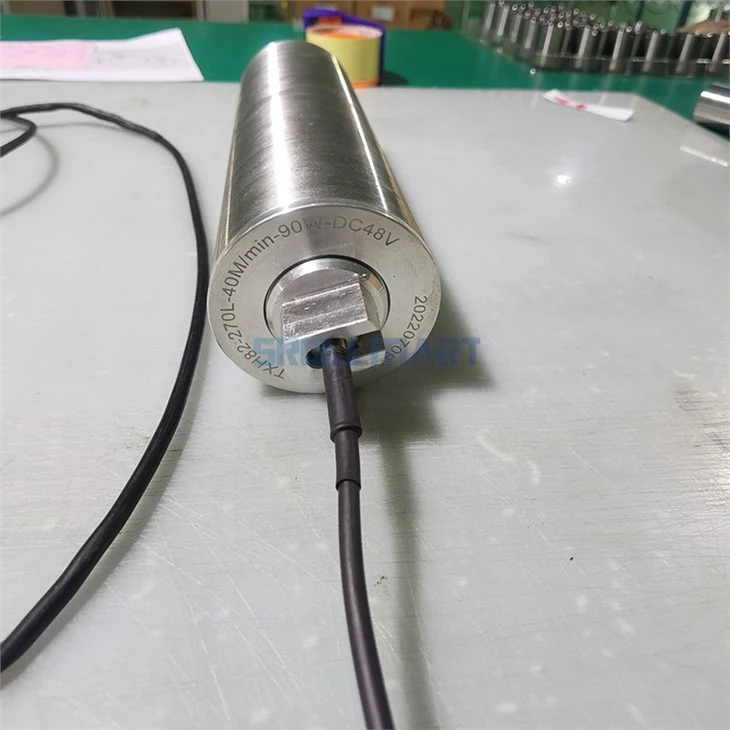

-
Improved Commutation Systems
We are constantly researching and developing new commutation techniques to improve the switching of current in the rotor windings. Advanced electronic commutation systems can provide more precise control over the current, reducing the sudden changes in torque that occur during commutation.
Our Product Range
We offer a wide range of 48V DC drum motors, including the 50/60mm 48V DC Electric Roller, 50mm 48v Dc Drum Motor, and 60mm 48V DC Drum Motor. All of our motors are designed with low torque ripple in mind, ensuring smooth and efficient operation.
Conclusion
Torque ripple is an important consideration when choosing a 48V DC drum motor. Understanding what it is, what causes it, and how it impacts motor performance can help you make an informed decision. At our company, we are committed to providing high - quality 48V DC drum motors with minimal torque ripple.
If you are interested in our products and would like to discuss your specific requirements, please feel free to reach out to us for procurement and negotiation. We look forward to serving you and providing the best motor solutions for your applications.
References
- Chapman, S. J. (2012). Electric Machinery Fundamentals. McGraw - Hill Education.
- Krause, P. C., Wasynczuk, O., & Sudhoff, S. D. (2013). Analysis of Electric Machinery and Drive Systems. Wiley.