




What is the starting current of a 48v Dc Drum Motor?
 Jan 22, 2026|
What is the starting current of a 48v Dc Drum Motor?
As a supplier of 48V DC drum motors, I often encounter inquiries about the starting current of these motors. Understanding the starting current is crucial for proper system design, component selection, and ensuring the reliable operation of the entire setup. In this blog post, I will delve into the concept of starting current, its significance in 48V DC drum motors, and factors that influence it.
What is Starting Current?
Starting current, also known as inrush current, is the instantaneous electrical current drawn by a motor when it is first energized. This current is typically much higher than the motor's normal operating current and lasts for a short period, usually a fraction of a second to a few seconds, depending on various factors.
The reason for the high starting current is that when the motor is at rest, there is no back electromotive force (EMF) generated. Back EMF is a counter-voltage that opposes the applied voltage as the motor rotates. Without back EMF, the electrical impedance of the motor is relatively low, and according to Ohm's Law (I = V/R), a lower impedance results in a higher current draw.
Significance of Starting Current in 48V DC Drum Motors
In the context of 48V DC drum motors, understanding the starting current is essential for several reasons:
-
Power Supply Capacity: The power supply must be able to handle the high starting current without overloading or experiencing voltage drops. If the power supply is undersized, it may not be able to provide the necessary current, leading to reduced motor performance, stalling, or even damage to the motor or power supply.
-
Circuit Protection: Overcurrent protection devices, such as fuses and circuit breakers, need to be properly selected based on the starting current. These devices should be able to withstand the short-term high current during startup while protecting the circuit from sustained overcurrents due to faults.
-
System Stability: High starting currents can cause voltage dips in the electrical system, which may affect other components connected to the same power source. This can lead to malfunctions or reduced performance of other equipment, especially if sensitive electronics are present.
Factors Influencing the Starting Current of a 48V DC Drum Motor
Several factors can influence the starting current of a 48V DC drum motor:
-
Motor Design: The design of the motor, including the number of windings, wire gauge, and magnetic properties, can affect its impedance and starting current. Motors with lower internal resistance will generally have higher starting currents.
-
Load Inertia: The inertia of the load connected to the motor plays a significant role in determining the starting current. A higher load inertia requires more torque to start the motor and accelerate the load, resulting in a higher starting current.

-
Starting Method: The method used to start the motor can also impact the starting current. Direct-on-line (DOL) starting, where the motor is directly connected to the power supply, results in the highest starting current. Other starting methods, such as soft starting or using variable frequency drives (VFDs), can reduce the starting current by gradually increasing the voltage or frequency applied to the motor.
-
Temperature: The temperature of the motor can affect its electrical resistance. As the temperature increases, the resistance of the motor windings also increases, which can reduce the starting current.
Calculating the Starting Current of a 48V DC Drum Motor
Calculating the exact starting current of a 48V DC drum motor can be challenging, as it depends on multiple factors. However, a rough estimate can be obtained using the following formula:
[I_{start} = \frac{V}{R_{start}}]
Where:
- (I_{start}) is the starting current (in amperes)
- (V) is the applied voltage (48V in this case)
- (R_{start}) is the motor's resistance at startup
The motor's resistance at startup can be difficult to determine precisely, as it may vary depending on the motor's design and temperature. In some cases, the manufacturer may provide the starting current value in the motor's datasheet. If this information is not available, it may be necessary to measure the starting current using appropriate test equipment.
Our 48V DC Drum Motor Offerings
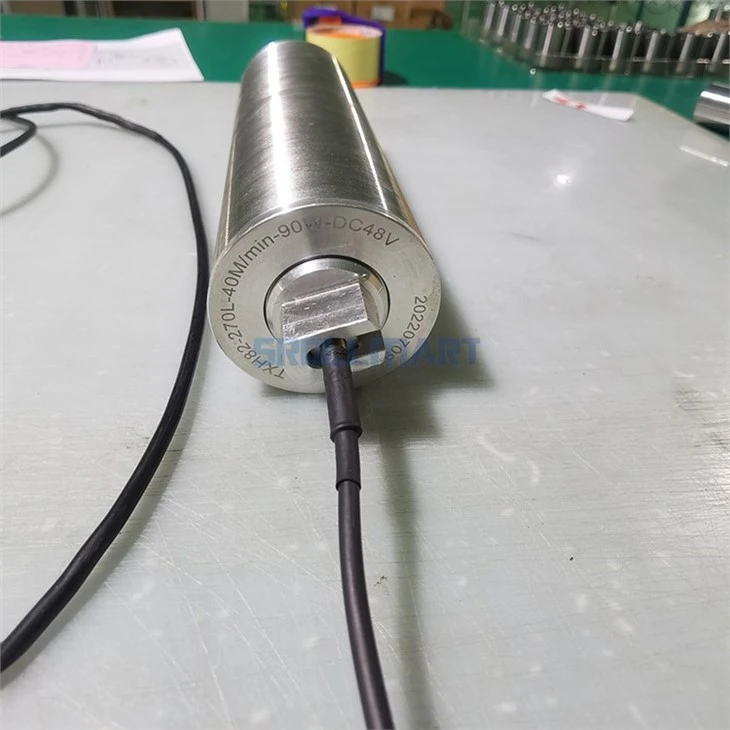
As a supplier of 48V DC drum motors, we offer a range of products to meet various application requirements. Our 50/60mm 48V DC Electric Roller is a popular choice for conveyor systems and other material handling applications. It features a compact design, high efficiency, and reliable performance.
We also offer dedicated 50mm 48v Dc Drum Motor and 60mm 48V DC Drum Motor options, which are optimized for specific diameter requirements. These motors are designed to provide smooth and efficient operation, with low starting currents to minimize the impact on the power supply.
Contact Us for Purchase and Consultation
If you are considering the use of a 48V DC drum motor in your application, we are here to help. Our team of experts can provide you with detailed information about the starting current, power requirements, and other technical specifications of our products. We can also assist you in selecting the right motor for your specific needs and offer guidance on system design and installation.
Whether you are a small business or a large industrial enterprise, we are committed to providing you with high-quality products and excellent customer service. Contact us today to discuss your requirements and start the process of purchasing the perfect 48V DC drum motor for your application.
References
- Fitzgerald, A. E., Kingsley, C., & Umans, S. D. (2003). Electric Machinery. McGraw-Hill.
- Chapman, S. J. (2012). Electric Machinery Fundamentals. McGraw-Hill.
- Grainger, J. J., & Stevenson, W. D. (1994). Power System Analysis. McGraw-Hill.